About this event
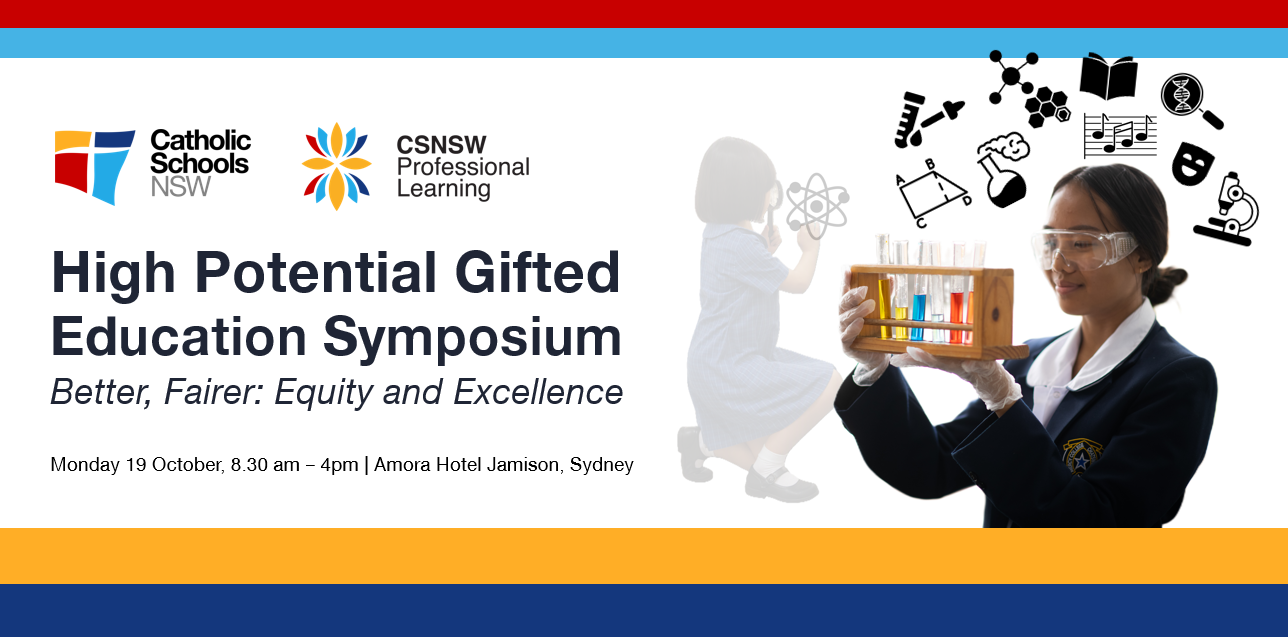
What if equitable practices in High Potential Gifted Education were the system’s defining measure of success, not an aspirational add‑on?
PLEASE NOTE: This Symposium has been extremely popular and is currently at capacity.
This symposium transcends academic achievement; it explores the vital intersection of social justice and intellectual rigour. We are moving beyond "one-size-fits-all" to discover how inclusive excellence can be woven into the fabric of every Catholic classroom.
WHY ATTEND?
- Expert Insights: Hear from leading voices in high potential gifted education on identifying and nurturing talent in diverse settings.
- Collaborative Spirit: Connect with peers committed to elevating the educational experience for high potential and gifted learners.
- Practical Strategies: Gain actionable tools to promote equity and excellence, ensuring no high potential or gifted student is left behind.
INTRODUCING YOUR KEYNOTE SPEAKERS
Dr Geraldine Townend
Deputy Head of School of Education (Learning & Teaching), UNSW
Geraldine is a published academic in the field of gifted education, having expertise in the areas of twice exceptionality and pedagogy to support creativity. Geraldine lectures and conducts research in GERRIC in the areas of gifted education, gifted learners with disability, and special learning needs. Her research interests focus on supporting gifted and twice-exceptional students to aspire to their potential in education, which includes the development of positive academic self-concept.
KEYNOTE: The opening keynote "Equity and Excellence in High Potential and Gifted Education: What the Evidence Tells Us”, is core to the theme of the Symposium.
Attendees will also be able to engage in a breakout session with Dr Townsend: “Beyond the Myths: Evidence-Based Perspectives on High Potential and Gifted Education”
Marisa Zadro
Curriculum Manager, Diversity, NSW Education Standards Authority (NESA)
In this role, Maria provides system-level leadership and advice on the education of diverse learners, including gifted students, students with disability, and English as an Additional Language or Dialect (EAL/D) learners. Marisa has contributed to the NSW Curriculum Reform initiative (2021-2027), helping to ensure all students, including high-potential and gifted learners, have access to challenging and high-quality learning opportunities.
With almost two decades of leadership experience in the independent and Catholic education sectors. Marisa is a passionate advocate for inclusive practices that enable all learners to thrive and achieve excellence.
KEYNOTE: “Spotlight on Curriculum - Designing for excellence – how the NSW curriculum supports gifted learners and talent development.”
Maria's presentation will outline how the reformed NSW Curriculum supports gifted learners through clearer essential content, evidence‑based sequencing, and stronger cross‑subject connections. It will also summarise NESA’s guidance on identification, assessment, and effective teaching strategies to ensure high expectations, coherent learning, and sustained talent development.
Thank you to our Keynote sponsors:
Every student deserves the chance to thrive, and you deserve the tools to help make that happen.
We support schools across Australia and New Zealand with easy-to-use assessments and reading programs that fit seamlessly into your day, providing clarity on what each student needs.
Whether you’re identifying learning gaps, building reading confidence, or tracking progress across your school, we provide you with the insight to act quickly and support growth and confidence in every learner.
Psychological Assessments Australia
Leading Provider of Psychological and educational assessments for over 30 years
We have much to be proud of. For 30 years, we have provided innovative assessment solutions for public safety, mental health, child development, education and speech and language professionals in Australia.
LEARN MORE
SYMPOSIUM PROGRAMME
In addition, the program features 12 breakout sessions, a dynamic panel discussion, and a plenary session - giving participants multiple ways to engage, learn and connect throughout the day with their Catholic colleagues from across NSW.
UNIQUE FEATURE OF CSNSW PL
A unique feature of CSNSW PL is that post-event, we do the hard work for you: we find the research and resources mentioned, we locate any media articles, embed videos and websites, we even try to find the best price on any books that presenters recommend!
You have EXCLUSIVE access as part of your registration and it is all presented in an accessible and engaging interactive format, which is easy for you to share with your colleagues back in your schools and dioceses to have those important learning conversations.
Getting there
Upcoming events
-
Read more about High Potential Gifted Education Symposium
High Potential Gifted Education Symposium
Catholic Schools NSW is proud to host its inaugural HPGE Symposium, exploring the theme “Better, Fairer: Equity and Excellence." -
Read more about High Potential Gifted Education Symposium
High Potential Gifted Education Symposium
Catholic Schools NSW is proud to host its inaugural High Potential and Gifted Education Symposium, exploring the theme “Better, Fairer: Equity and Excellence.” -
Read more about Studies of Religion Teachers – Have Your Say!
Studies of Religion Teachers – Have Your Say!
Studies of Religion Teachers – Have Your Say! -
Read more about 2027 Catholic Schools NSW Aboriginal and Torres Strait Islander Education Conference
2027 Catholic Schools NSW Aboriginal and Torres Strait Islander Education Conference
2027 Catholic Schools NSW Aboriginal and Torres Strait Islander Education Conference