Scholaris newsletter 11/8/2026
Priority
NESA updates – 10 August 2026 (Ref: 165/26)
NESA Official Notices
NESA Official Notices can be accessed here
NESA Timetable of action for secondary schools
Timetable of action for secondary schools can be accessed here
HSC Exams begin for almost 13,000 students!
2026 HSC exams have officially begun in NSW, with 12,958 students set to complete Languages oral and performance exams over the next six weeks.
Languages oral exams started on Saturday. Almost 5,000 Language students will complete their oral exams throughout this period.
From this week, 8,487 Dance, Drama and Music students will start their performance exams and submit their compositions.
All the best to the HSC Class of 2026 who will complete an exam, and to those handing in major works.
HSC Study Guide: HSC tips from high achievers, teachers, markers and an astronaut
- Three CALLBACK performers share their tips for HSC Dance.
- HSC markers, teachers and 2025 high-achieving HSC students share their advice for success across a variety of other subjects.
- Get inspired by some famous faces who share their experiences about their own HSC exams.
Click here to see HSC Key Dates
New SHAPE showcase project directory now available
NESA's new SHAPE project directory gives you access to all the outstanding HSC Design and Technology, Industrial Technology and Textiles and Design major projects selected for this year's SHAPE showcase.
Search by subject, HSC year, or project category to explore the creativity, innovation, and technical skills showcased by NSW students.
Click here to explore the SHAPE project directory.
Get ready for Science Week 2026
National Science Week 2026 runs from Saturday 15 to Sunday 23 August and the theme is ‘Seeds of Science: Nurturing knowledge for all.’
Teachers can use the theme to support students in observing, testing, gathering evidence, and sharing ideas through real-word investigations.
| Key Dates | |
|---|---|
| From now | |
| 15 August | ARTEXPRESS opens at Western Plains Cultural Centre, Dubbo |
| 28 August | ARTEXPRESS opens at Hawkesbury Regional Gallery |
| 29 August | ARTEXPRESS opens at Bondi Pavilion Gallery |
| 31 August | |
| 15 September | |
By subscribing to NESA News, you will receive the latest updates and information as soon as it becomes available.
Subscribe to NESA News here
Professional Learning
Registrations now open for High Potential and Gifted Education Symposium – Better, Fairer: Equity and Excellence (Ref: 166/26)
Catholic Schools NSW is pleased to announce that registrations are open for the inaugural High Potential and Gifted Education Symposium, on Monday 19 October 2026. Thanks to overwhelming interest and an outstanding speaker lineup, limited places are set to fill up fast for this event.
About the Event
Key features of the day include two keynotes, 12 breakout sessions, a dynamic panel discussion, and a plenary session. An excellent opportunity to engage, learn and connect throughout the day with your Catholic colleagues.
Date: Monday 19 October
Time: 8:30 am – 4:00 pm
Where: Amora Hotel Jamison, Sydney
Register: To learn more and register, click here.
About your Keynote Speakers
Dr Geraldine Townend is Deputy Head of School of Education (Learning & Teaching), at UNSW. As a prominent lecturer and researcher in the field of gifted education, twice-exceptionality, and creativity and innovation education, she also contributes to Gifted Education Research and Resource Information Centre (GERRIC).
Her opening keynote, Equity and Excellence in High Potential and Gifted Education: What the Evidence Tells Us, is core to the theme of the Symposium.
Attendees will also be able to engage in a breakout session with Dr Townend: Classroom strategies that best support high potential, gifted and twice-exceptional students.
Along with being Curriculum Manager at NESA, our second keynote speaker Marisa Zadro, is a Lecturer and Doctoral Candidate at UNSW. Her presentation, Spotlight on Curriculum: Designing for excellence – how the NSW curriculum supports gifted learners and talent development, will explore how the NSW Curriculum is designed to be flexible and responsive to the needs of gifted learners, while supporting talent development across diverse domains.
Why attend?
Participants will engage with well‑designed, research‑informed strategies that bridge the gap between theory and classroom practice, empowering educators to nurture the full potential of every learner.
- Expert Insights: Hear from leading voices in high potential gifted education on identifying and nurturing talent in diverse settings.
- Collaborative Spirit: Connect with peers committed to elevating the educational experience for high potential and gifted learners.
- Practical Strategies: Gain actionable tools to promote equity and excellence, ensuring no high potential or gifted student is left behind.
Workshop Sessions – Preparing for the New K-6 Science & Technology Syllabus (Ref: 181/26)
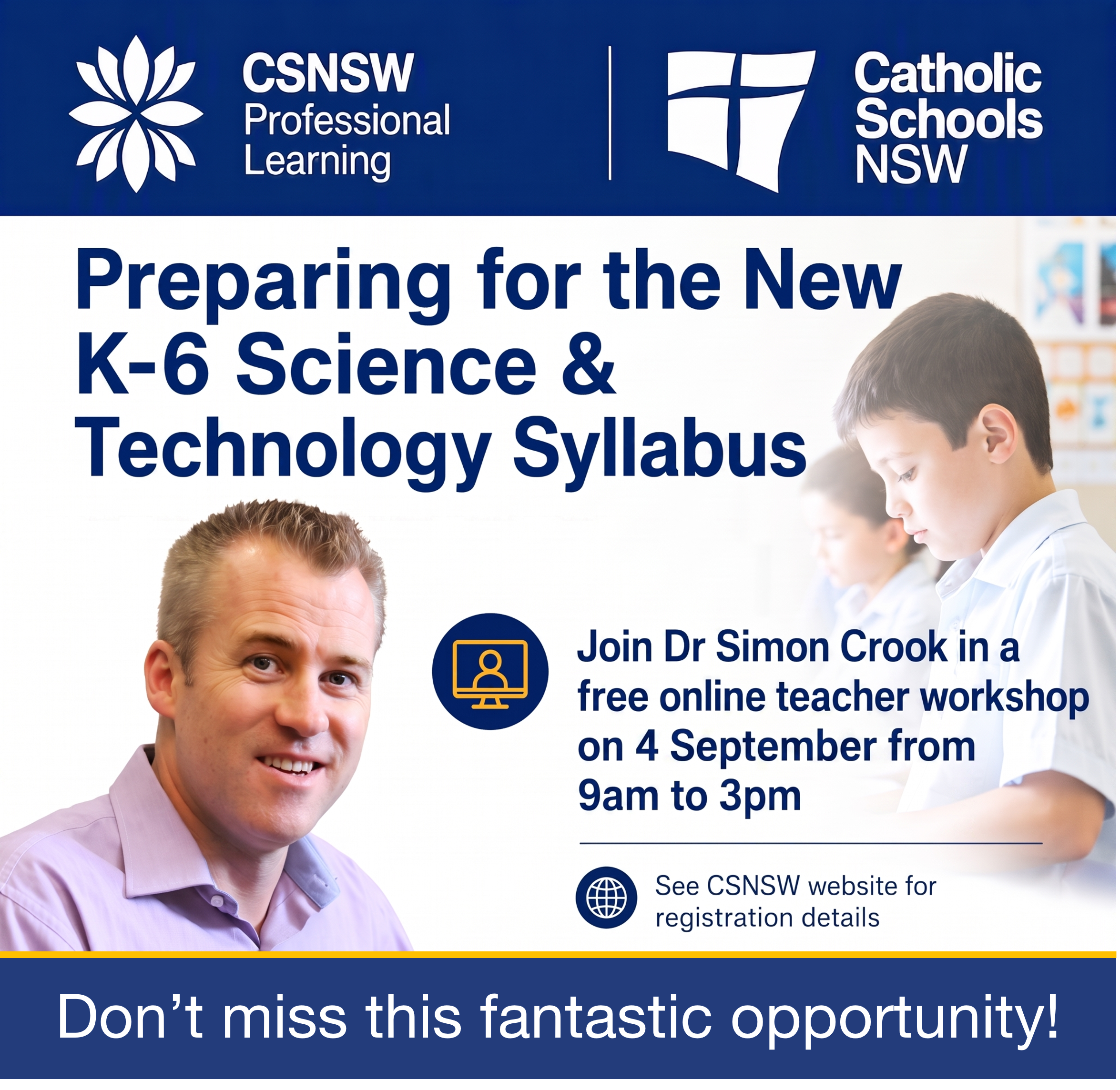
Dr Simon Crook will run an online workshop for teachers in preparation for the implementation of the new K-6 Science and Technology Syllabus. At the recent CSNSW Curriculum Reform conference, Dr Crook examined and discussed the STEM content in the newly released K-6 Science and Technologies syllabus. These workshops will focus on implementation strategies to support K-6 teachers for full implementation of the syllabus by the start of 2027.
Date(s): Friday 4 September 2026
This event will be repeated on 18 September 2026 and 10 November 2026
Time: 9:00am – 3:00pm
Format: Online Zoom
A link will be sent to registered participants prior to the event
Please visit the CSNSW website to register for one of these workshops.
Integrating the Live Life to the Full Program: A Whole School Approach (Ref: 164/26)
Live Life to the Full has recently launched across CSNSW, giving schools a Catholic-informed program to teach consent and respectful relationships, but rolling it out well takes more than platform access it takes a clear plan for staff professional learning, sequencing and support.
Join Karen Doyle, Founder of Live Life to the Full, for a practical, hands-on session for school and system leaders. Karen will walk through how to introduce the program to different stakeholder groups, from teachers and wellbeing staff to school executive, and share simple ways to sequence the rollout so it doesn't overwhelm staff.
The session will focus heavily on the practical: how to prepare teachers to deliver sensitive content with confidence, what to put in place before lessons begin, and the key tips and common pitfalls picked up from schools already using the platform.
Ideal for Principals, Assistant Principals, Wellbeing Leaders, PDHPE and Religious Education Coordinators and other system leaders, this session will leave you with a clear, workable starting point for embedding Live Life to the Full in your school.
Date: Thursday August 27
Time: 3:30 pm – 4:30 pm
Format: Online
To register, click here.
Student Resources
Modern Slavery in Schools (Ref: 180/26)
Does your school have a plan to educate young Australians about modern slavery and forced labour? ACAN can help raise awareness among your young Catholic high school students.
Moe Turaga is the Lived Experience Advisor at the Australian Catholic Anti-Slavery Network. He is a survivor of modern slavery and has shared his story with people all over Australia and around the world.
Working with Moe
Your school can work with ACAN to help young students learn more about modern slavery, forced labour and human trafficking.
With forced-labour scams posing a growing risk across the Asia-Pacific region, Moe teaches students how to recognise the signs and know how to respond.
Moe runs workshops that help young people recognise and avoid exploitative workplace practices.
In response to Pope Leo XIV’s call to break “the chains of new forms of slavery,” Catholic schools can partner with Moe to build informed and vigilant school communities that prevent modern slavery and help people at risk of labour exploitation.
More information can be read on: Moe’s mission to schools — Australian Catholic Anti-Slavery Network
Book Moe on: CSNSW_ACAN 2026 modern slavery raising awareness in schools

School’s in – on the Great Barrier Reef (Ref: 163/26)
The Great Barrier Reef is a classroom like no other. Now a new national program is offering more Australian school students the learning experience of a lifetime by subsidising school excursions to the Reef.
The $6 million ‘Kids for the Reef’ program is making rebates available from the Australian Government for eligible Year 4 to Year 12 students.
Pupils can boat through amazing ecosystems, take part in snorkel surveys of vibrant sea life, study marine science and conservation, or embark on many other approved educational activities.
The program is open to public, private, independent and Catholic schools, as well as registered home educators, across the country. Rebates generally range from $20-$400 per student, based on distance. However, payments may rise to around $1,600 per student for very remote schools with low ICSEA (socio-educational) scores.
The Kids for the Reef School Excursion Rebate Program runs until June 2028, but it helps to apply early. Applications are assessed in order of receipt until all funds are allocated.
Read more about Kids for the Reef: Kids for the Reef school excursion rebate program | Austrade

Legal and Policy
Protecting Students From AI-Generated Deepfakes (Ref: 168/26)
Schools and teachers should be careful when deciding to post photos or videos of students online. This article provides practical guidance on how to reduce risk and respond in the case of a critical online incident.
Why publicly shared school and student photos carry more risk
With the increasing availability of AI-tools, publicly available photos posted by schools can now be used as source material for digitally altered images or sexualised deepfakes.
What can schools do to reduce risk?
Schools must be cautious when deciding to post photos or videos of their students or staff online. Fewer images of students and staff online means fewer risks, and schools should only post where these risks can be suitably mitigated.
The eSafety Commissioner has provided guidance on how schools can safely share photos online (which can be found here: Sharing school imagery in the age of AI: risks, deepfakes, and how to protect students and staff | eSafety Commissioner). eSafety recommends that before posting, a risk-based approach should be undertaken, taking the following factors into consideration:
- Understand the purpose of sharing.
- Confirm that the child or staff’s consent is active, informed, current, and recorded, and applies to the school’s social media posts.
- Determine whether the post can identify a specific person.
- Consider the account the image will be posted on and the audience.
- Consider alternative angles for taking the photo or the possibility of editing before posting.
- Review and ensure strong privacy settings for the account and controls for tags and comments on posts.
- Decide on a governance structure for the approval of content and recording consents.
- Review archived material with a privacy lens.
- Implement good privacy practices in relation to data storage, retention and disposal.
What can schools do to prevent a critical online incident?
Schools need to give students clear guidance about AI-edited content, including education about how creating deepfakes can result in criminal charges.
Teachers can use the Best Practice Framework for Online Safety Education to help build students’ digital literacy.
Schools can update their student behaviour policies to cover AI-manipulated content and the posting of online images, including having a critical online incident plan. See the eSafety’s Toolkit for Schools.
What should schools do when an image is misused?
In the event of a critical online incident, schools should follow their response plan and the student behaviour policies in place.
The eSafety Commissioner recommends the following response:
- Collect evidence before reporting or blocking an account.
- Report the content or account to the service.
- Communicate with families carefully.
- Plan for content to reappear and keep those affected informed.
In some cases, schools may need to report the incident to the eSafety Commissioner, report the incident to the police, or seek legal advice if it is appropriate to do so.
More information
For more information about sharing school images appropriately, please refer to the eSafety Commissioner’s advisory: Sharing school imagery in the age of AI: risks, deepfakes, and how to protect students and staff | eSafety Commissioner . In addition, the eSafety’s Toolkit for Schools contains a range of resources to help schools to manage and respond to online safety incidents.
Previous issues
-
Read more about Scholaris newsletter 20/10/2026
Scholaris newsletter 20/10/2026
In this week's newsletter: Professional Learning, Student Resources, School Updates and Newsletters, Employment Opportunities, Scholarships and Awards, and other Priority items. -
Read more about Scholaris newsletter 13/10/2026
Scholaris newsletter 13/10/2026
In this week's newsletter we cover: Professional Learning, Student Resources, School Updates and Newsletters, Employment Opportunities, Scholarships and Awards, and other Priority items. -
Read more about Scholaris newsletter 6/10/2026
Scholaris newsletter 6/10/2026
In this week's newsletter we cover: Professional Learning, Student Resources, School Updates and Newsletters, Employment Opportunities, Scholarships and Awards, and other Priority items. -
Read more about Scholaris newsletter 29/9/2026
Scholaris newsletter 29/9/2026
In this week's newsletter we cover: Professional Learning, Student Resources, School Updates and Newsletters, Employment Opportunities, Scholarships and Awards, and other Priority items. -
Read more about Scholaris newsletter 22/9/2026
Scholaris newsletter 22/9/2026
In this week's newsletter we cover: Professional Learning, Student Resources, School Updates and Newsletters, Employment Opportunities, Scholarships and Awards, and other Priority items. -
Read more about Scholaris newsletter 15/9/2026
Scholaris newsletter 15/9/2026
In this week's newsletter we cover: Professional Learning, Student Resources, School Updates and Newsletters, Employment Opportunities, Scholarships and Awards, and other Priority items. -
Read more about Scholaris newsletter 8/9/2026
Scholaris newsletter 8/9/2026
In this week's newsletter we cover: Professional Learning, Student Resources, School Updates and Newsletters, Employment Opportunities, Scholarships and Awards, and other Priority items. -
Read more about Scholaris newsletter 1/9/2026
Scholaris newsletter 1/9/2026
In this week's newsletter we cover: Professional Learning, Student Resources, Legal and Policy and other Priority items. -
Read more about Scholaris newsletter 25/8/2026
Scholaris newsletter 25/8/2026
In this week's newsletter we cover: Professional Learning, Student Resources, Legal and Policy and other Priority items. -
Read more about Scholaris newsletter 18/8/2026
Scholaris newsletter 18/8/2026
In this week's newsletter we cover: Professional Learning, Student Resources, Legal and Policy and other Priority items. -
Read more about Scholaris newsletter 4/8/2026
Scholaris newsletter 4/8/2026
In this week's newsletter we cover: Professional Learning, School Updates and Newsletters, Scholarships and Awards, Legal and Policy and other Priority items. -
Read more about Scholaris newsletter 28/7/2026
Scholaris newsletter 28/7/2026
In this week's newsletter we cover: Professional Learning, School Updates and Newsletters, Scholarships and Awards, Legal and Policy and other Priority items.
Sign up to Scholaris
Your weekly Catholic Schools NSW e-bulletin.